

A guide to key roles, responsibilities, and regulatory obligations in the French film and TV industry
Key eco-production roles explained
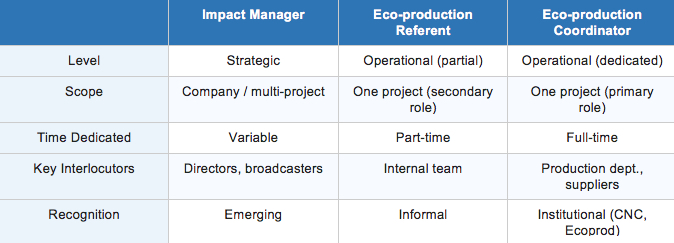
Three distinct professional profiles have emerged in response to the obligations explained below.
While they share a common mission which consists in reducing the environmental impact of productions, they differ significantly in their scope of action, seniority, and organisational positioning.
Impact Manager
The Impact Manager is the most strategic of the three profiles mentionned in this article. This role is typically found within production companies, studios, or distribution groups, operating at organisational rather than project level.
- Develops and drives the company’s overall sustainability strategy and CSR (Corporate Social Responsibility) policy;
- Sets quantified environmental targets across the portfolio (carbon reduction goals, waste elimination targets, sustainable procurement targets, energy consumption objectives, etc.);
- Acts as the primary interlocutor for executive management, broadcasters, investors, and public funders;
- Oversees multiple productions simultaneously in a supervisory capacity, rather than embedding directly on set;
- Typically holds a permanent (CDI) position within the company structure;
- Combines project management, environmental expertise, and strategic communication skills.
The Impact Manager role is still emerging in France and is more commonly found in larger, internationally-oriented companies. It draws on practices from the broader corporate sustainability world and adapts them to the specificities of content production.
Eco-production Referent
The Eco-production Referent is an operational role, but one that is typically assigned to an existing team member in addition to their primary responsibilities rather than being a dedicated standalone position.
- Who embed the position? Often a production manager, line producer, production assistant or production coordinator who takes on this remit for a specific project;
- Raises environmental awareness within the team, coordinates the carbon assessment, and ensures the production follows its action plan;
- Collects and consolidates environmental data from all departments for reporting purposes, carbon footprint assessment or labeling (Ecoprod);
- More commonly found in smaller production structures or on mid-scale projects that lack the budget for a fully dedicated coordinator;
- Carries less formal institutional recognition than a dedicated coordinator.
This profile is a pragmatic solution for productions that need to meet regulatory and broadcaster requirements but cannot resource a full-time specialist. The risk is that environmental obligations are deprioritised when competing with the référent’s primary responsibilities. It also means saving one job in the production budget.
Eco-production Coordinator
The Eco-production Coordinator is a fully dedicated operational role, 100% focused on environmental issues throughout the lifecycle of a production. This is the profile that is most clearly recognised and incentivised by French institutional frameworks (the CNC and Ecoprod).
- Joins the production from the preparation phase and remains through to the final environmental report;
- Works directly and daily with the production department, art department, catering providers, and transport coordinators;
- Manages concrete on-the-ground initiatives : waste sorting systems, renewable energy sourcing, sustainable catering options, material reuse and rental strategies;
- Builds the environmental action plan, tracks progress against it, and produces the post-shoot bilan;
- Holds specific professional training in eco-production (via Ecoprod, the CNC, or ARPE-accredited training providers);
- Is the profile implicitly expected by the CNC and Ecoprod when they require a named eco-production professional.
The Eco-production Coordinator represents the gold standard of the discipline. Their full-time presence on a production ensures that environmental considerations are integrated at every decision point – from location scouting to set construction, wrap logistics to caterer selection.
The challenge of responsible audiovisual production
The audiovisual and film industry has a significant environmental footprint. A feature film shoot typically generates between 500 and 2,500 tonnes of CO₂ equivalent, driven by energy consumption on set, large-scale logistics, transportation of cast and crew, and the volume of materials produced and discarded. Television productions, advertising shoots, and digital series add substantially to this collective impact.
Across Europe, and in France in particular, the sector has entered a period of structural transformation. Growing awareness among audiences, increased pressure from broadcasters and public funders, and an evolving regulatory framework are compelling production companies to rethink how they work from the earliest stages of development through to post-production.
Eco-production is no longer a niche concern or a communication exercise. It has become a professional discipline in its own right, supported by dedicated tools (such as the Ecoprod calculator or Seco2 from Secoya), industry-wide standards, and – increasingly – enforceable legal requirements. This shift has given rise to a new ecosystem of specialised roles whose purpose is to embed environmental responsibility into every stage of production.
Legal and Institutional Obligations
The CNC and Eco-conditional Funding
The Centre national du cinéma et de l’image animée (CNC) is the French state body responsible for supporting and regulating the film and audiovisual sector. In recent years, the CNC has progressively introduced environmental criteria into its funding mechanisms.
Since 2021, certain CNC funding streams, particularly the selective aid for fiction, documentary, and animation, have made eco-production engagement a condition of eligibility or a scoring criterion. Productions applying for support are increasingly expected to :
- Appoint a dedicated eco-production coordinator or referent;
- Complete a carbon footprint assessment using a recognised tool (typically the Ecoprod calculator or an equivalent approved methodology such as Seco2 from Secoya);
- Submit a documented environmental action plan as part of the funding application;
- Provide a post-production environmental report.
This shift reflects a broader policy direction that public money in the cultural sector should not fund productions that make no effort to reduce their environmental impact.
The Ecoprod Label and Charter
Ecoprod is a professional association founded in 2009 by leading French broadcasters (including France Télévisions, Arte, Canal+, TF1 and M6) and producer organisations. Its mission is to develop and disseminate eco-production practices across the French audiovisual and film industry.
Ecoprod has developed the reference carbon calculator used across the French industry. It is a free and standardised tool that allows productions to measure and track their greenhouse gas emissions across all departments.
Beyond the calculator, Ecoprod offers a certification and labelling system. Productions that commit to a structured process of environmental assessment, action, and reporting can obtain the Ecoprod label. To be eligible, productions must :
- Designate a trained eco-production professional (coordinator or referent);
- Conduct a pre-production carbon assessment;
- Implement a set of concrete reduction measures across key emission sources;
- Produce a final environmental report validated by Ecoprod.
The Ecoprod charter, signed by major broadcasters and commissioners, has become a de facto industry standard. Productions that are commissioned by charter signatories are often contractually required to follow its guidelines.
Broadcaster Requirements
France Télévisions, Arte, Canal+ and other major broadcasters have integrated eco-production requirements into their commissioning contracts. Productions receiving funding or broadcast slots from these organisations are typically required to complete an Ecoprod carbon assessment, appoint a named eco-production contact, and provide end-of-shoot environmental data. Non-compliance can affect future commissioning relationships.
General conclusion
The emergence of these three roles reflects a maturing industry. What was once the voluntary commitment of a few forward-thinking producers has become, through the combined pressure of regulatory requirements, broadcaster contracts, and public expectations, a standard component of professional production practice in France.
For producers and commissioners, understanding the distinction between these roles is essential to making informed decisions about how to resource environmental responsibilities. An impact manager can anchor a company-wide strategy, an eco-production coordinator ensures it is lived on set every day, and an eco-production referent offers a bridge solution for smaller operations navigating the same obligations with fewer resources.
As the CNC and Ecoprod continue to tighten their requirements, and as broadcasters align their commissioning practices accordingly, the ability to demonstrate genuine, measurable environmental engagement will become an increasingly non-negotiable condition of doing business in the French audiovisual sector.
Personal conclusion
The French audiovisual and film industry deserves praise for imposing environmental obligations on content producers, particularly regarding the impact of climate change. The Ecoprod label does remarkable work raising awareness among audiovisual decision-makers and technicians about changing their production methods and working practices, with a focus on sustainable development. Indeed, specific guides, such as the one on filming in natural environments, address issues related to biodiversity and pollution stakes, for instance.
Since March 2023, regulatory obligations have been gradually implemented. It is thanks to legislation, which is Law, that habits are changing and mindsets are evolving towards a sector committed to becoming more sustainable while respecting planetary boundaries.
We clearly need to go further, and I want to emphasize that beyond the carbon footprint, which is one of the major current challenges in terms of climate change due to greenhouse gas emissions, we mustn’t forget both social and governance aspects, which currently seem to be the neglected aspects of production certification. Change management must also be a gradual process, adapting to the mindset of French workers in the audiovisual and film sector. This obviously requires a considerable effort from existing staff on set as well as those in the offices, because everyone must be involved in this mission to save the French audiovisual and film industry.

Author : Fabrice Delobette