
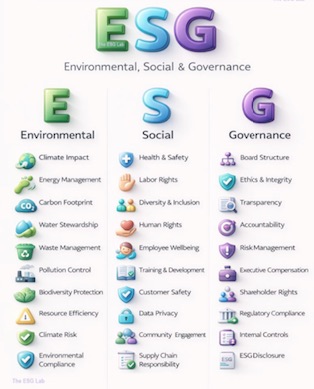
The framing is sharp — ESG as a label is indeed losing ground, particularly in the US where seventeen states have restricted its use in public funds, and a federal court suspended parts of the SEC’s climate regulations. But the underlying substance isn’t disappearing — it’s being disaggregated into more operational, business-relevant tools. Here are the three elements you mentioned, detailed:
1. Physical Risks
Physical risks are the direct financial and operational impacts of climate change on a company’s assets, supply chains, and activities. They fall into two categories: acute (sudden events) and chronic (slow-onset degradation).
Companies are now facing new physical risks such as fires or storms alongside increasing scarcity of critical resources, sharply rising energy costs, and regulatory constraints on carbon emissions. These are no longer abstract threats: their consequences are increasingly visible, growing in frequency and intensity like floods, tropical cyclones, heatwaves, droughts, wildfires, species loss.
The financial materiality is now undeniable. The 2025 World Economic Forum Global Risks Report now ranks supply chain risks among the five most threatening of the decade. Physical risks are assessed through scenario analysis, prospective scenarios are a tool of choice for grasping long-term ESG risks, in particular physical climate risks that amplify over decades.
The key frameworks used: TCFD (Task Force on Climate-related Financial Disclosures) and the ISSB standards (IFRS S1/S2), which operationalize physical risk disclosure into financial reporting.
Volkswagen & the Los Angeles Wildfires
Volkswagen (supply chain disruption, 2023–2024)
This is one of the clearest documented cases of physical climate risk translating into financial loss. Severe 2023 floods in Slovenia, a critical hub for European automotive Tier-1 suppliers, had a major domino effect, forcing manufacturers like Volkswagen to cut production due to the limited delivery of essential components, with an estimated 150,000 fewer cars produced globally that year. Volkswagen’s own annual report acknowledged the mechanism formally: their procurement teams were put to the test securing parts from flooded areas, and the group now systematically analyzes the impacts of climate change on its production sites to gauge potential risks and recommend action.
This wasn’t a one-off. In May 2024, devastating floods in Brazil’s Rio Grande do Sul halted production at ten automotive manufacturers including VW, GM, and Stellantis, in the worst flooding the country had seen for 80 years.
The Los Angeles wildfires (2025)
The January 2025 LA wildfires caused an estimated $76–$131 billion in property and capital losses, while Hurricanes Helene and Milton in 2024 together cost $113 billion in total. Swiss Re reported that global insured losses from natural catastrophes reached nearly $140 billion in 2024 alone.
2. Climate Targets
Climate targets are the quantified, time-bound commitments companies make to reduce their greenhouse gas emissions, increasingly aligned with the Paris Agreement’s 1.5°C pathway.
The ESRS E1 standard defines for the first time in regulation a holistic framework for transparency expectations around a climate transition plan compatible with limiting warming to +1.5°C above pre-industrial levels by 2100.
These targets are structured across three scopes of emissions (direct, indirect from energy, and value chain), and decarbonation objectives consist primarily of reducing gross GHG emissions, carbon offsetting and removals only come into play secondarily and for a very limited volume of residual emissions. In practice, most companies still face difficulties obtaining or estimating Scope 3 data for their upstream and downstream value chains.
Importantly, targets are only credible if they are science-based and short/medium-term milestones exist, transition plans must include clear timelines, interim targets, and quantifiable milestones. The Science Based Targets initiative (SBTi) is the dominant validation body for corporate climate targets globally.
Unilever & the tech giants (with caveats)
Unilever, a benchmark, but still imperfect
Unilever’s Climate Transition Action Plan, backed by over 97% of shareholders at its 2024 AGM, targets a 100% absolute reduction in Scope 1 and 2 emissions against a 2015 baseline, a 42% absolute reduction in Scope 3 energy and industrial emissions, and a 30.3% reduction in Scope 3 land and agriculture emissions. These are validated by the SBTi. With 99% of emissions arising outside their own operations, Unilever is shifting focus to the value chain, engaging suppliers and targeting 1 million hectares of land under regenerative agriculture by 2030.
The tech sector, a cautionary tale
The same targets framework can be gamed. A 2025 analysis of Amazon, Apple, Google, Meta, and Microsoft found that energy demand at their data centers grew 12% annually from 2017 to 2024, leading researchers to conclude that “tech companies’ GHG emissions targets appear to have lost their meaning and relevance.” Apple is a partial exception: it has cut emissions by 60% since 2015, but its calculations rely heavily on avoided-emissions estimates and on pushing key suppliers to bring 17.8 gigawatts of renewable capacity online.
3. Transition Plans
Transition plans are the operational documents that describe how a company will actually achieve its climate targets, the strategy, investment, governance, and execution roadmap.
More than long-term net-zero commitments, what matters is a comprehensive understanding of the company’s actual transformation capacity: governance, strategic evolution, identification of decarbonation levers, mobilisation of dedicated financing, and monitoring and reporting on plan execution.
Under the CSRD/ESRS framework, the application of ESRS standards should not be seen merely as a transparency exercise, it requires companies to translate their long-term decarbonation objectives into short- and medium-term planning horizons, aligned with the company’s financial planning cycle.
For financial institutions specifically, the EBA now requires institutions to prepare detailed transition plans outlining how they will manage financial risks arising from the EU’s move toward climate neutrality by 2050, aligned with EU climate objectives including carbon neutrality by 2050.
A well-governed transition plan also has a board dimension: a 2025 World Bank report highlights that companies with climate-competent boards are two to three times more likely to reach their objectives.
NatWest Group
NatWest, a banking sector leader
NatWest is one of the most documented examples in financial services of a legally structured transition plan. Between July 2021 and June 2025, NatWest provided £110.3 billion in climate and sustainable funding and financing, exceeding its target of £100 billion, and it also achieved its goal to provide £10 billion in lending for energy-efficient (EPC A and B rated) residential properties.
Their plan goes beyond targets to governance: the proposed 2025 NatWest performance share plan includes a 15% weighting for sustainability metrics, including climate targets, subject to shareholder approval.
On portfolio decarbonization: NatWest has developed nine portfolio-level, activity-based targets with convergence pathways referenced to external scenarios, and six out of nine are aligned to decarbonisation pathways as of end 2024. They also publicly acknowledge data limitations, financed Scope 3 emissions estimates rely on the PCAF standard and year-on-year fluctuations are expected as customer data and methodologies improve. That level of methodological transparency is itself considered good practice.
ESG as a three-letter brand may be fading, but what’s replacing it is more granular and more financially binding, physical risk quantification embedded in financial statements, science-based emission targets with interim milestones, and legally required transition plans. The shift is from reporting sustainability to managing it as core business risk.
The honest answer is: the label is dying in the US; the substance is being restructured everywhere else. Here’s the full picture as of March 2026:
The label is in retreat especially in the US
Only 25% of S&P 100 companies used the term “ESG” in their annual sustainability reports in 2024, down from 40% in 2023, and from companies that had reported by early 2025, only 6% used the term at all. This isn’t organic evolution, it’s political pressure. Companies have increasingly pivoted to “climate hushing” or “greenhushing,” deliberately downplaying or concealing their sustainability progress to avoid backlash.
The Trump administration accelerated this: the SEC under Chair Paul Atkins stopped defending its climate-risk disclosure rule in court and scrapped a range of Biden-era proposals, including rules requiring increased disclosures for ESG-labeled funds.
But the money hasn’t moved
A 2025 BNP Paribas survey found that 87% of asset managers say their ESG and sustainability objectives remain unchanged, while 84% believe the pace of sustainability progress will continue or accelerate through 2030. The global ESG fund universe maintained $3.16 trillion in assets at the end of Q1 2025. US ESG fund outflows are real but don’t come close to the trillions in ESG assets estimated worldwide.
Europe: regulatory restructuring, not retreat
In Europe, the story is a simplification of scope, not abandonment of principle. The EU’s Omnibus package raises the CSRD employee threshold from 250 to 1,000 and the turnover threshold to €450 million which would exclude roughly 80% of companies from mandatory reporting. But the rules remain binding for large companies, and new mechanisms are going live: the EU Carbon Border Adjustment Mechanism (CBAM) pricing carbon in imported goods goes live in 2026.
The legal landscape is a genuine wild card
This is the most dynamic front in 2026. Anti-ESG legislation is being challenged in courts: in February 2026, a federal judge struck down a Texas anti-ESG law as unconstitutionally overbroad under the First Amendment and vague under the Fourteenth Amendment. Simultaneously, greenwashing litigation keeps expanding: over 150 US greenwashing class actions were tracked through early 2025, with California and New York as the most active venues.
As scrutiny of transition plans increases from both pro- and anti-ESG stakeholders, businesses need proactive governance to adapt to changing parameters, regular reviews of target feasibility, and appropriate stakeholder transparency.
The verdict
What changed is not the existence of ESG, but the standard of evidence required to support it. The market is moving away from broad positioning and toward data, that is not the death of ESG, it is the cost of credibility rising.
In 2026, companies should pivot toward communicating strategies rooted in stakeholder materiality and focused on specific climate actions that drive business value.
In short, ESG as a brand is a liability in the US. ESG as a risk management framework is becoming more rigorous, more legally exposed, and more financially integrated everywhere. The three elements you identified earlier, physical risks, climate targets, transition plans, are precisely what’s left when you strip away the label.